Data centers are now among the most water‑intensive industrial facilities in the country, and regulators are catching up. As NPDES discharge limits tighten and water‑reuse mandates expand, operators and engineers designing onsite cooling water treatment systems are finding that chemical programs alone are no longer enough. The biological aeration stage, often the least specified and most under‑engineered component, ultimately determines whether downstream membranes perform reliably or fail within months. 

Why Cooling Towers Produce Complex Wastewater

Cooling towers reject heat through evaporation. Every cycle of concentration that passes through the system leaves dissolved solids, hardness, silica, chlorides, and treatment chemical residues behind in the remaining water. That concentrated water-  the blowdown, is the primary wastewater output from data center cooling operations.                                                                        


For a large facility operating at four cycles of concentration, roughly 25–30% of total makeup water  becomes blowdown. At scale, that is millions of gallons per year per facility. And because water is used cyclically in the cooling process, the contaminant profile in blowdown is more complex than most municipal treatment plants are designed to handle.                                                   


The organic load is what creates the downstream problem. Blowdown carries biofilm fragments, surfactants from treatment chemicals, and degradation products from azole-based corrosion inhibitors. Left untreated, this organic content fouls the reverse osmosis and ultrafiltration membranes that most high-recovery reuse systems depend on, rapidly and expensively.                                    


Advanced treatment systems can recover 70–90% of cooling tower blowdown for reuse as makeup water.  Getting there requires a complete treatment train and biological aeration is the step that makes the rest of that train work.     
The Full Treatment Train — And Where Aeration Fits

A properly designed onsite wastewater treatment system for data centers operates as a coordinated treatment train, with each stage protecting the performance of the next: 

  • Equalization — Buffers variable cooling tower blowdown flows and concentrations
  • Biological treatment — Aerated processes (such as activated sludge or MBBR) remove BOD and COD
  • Biomass separation — Settles or retains biological solids, depending on process configuration
  • Membrane filtration
    • UF removes residual suspended solids and protects downstream processes
    • RO removes dissolved solids and salts for reuse or compliant discharge
  • Reuse or discharge — Treated water is returned to the cooling system or released under permit limits

Aeration is central to stage two: biological treatment. While membrane selection and configuration are critical to overall system performance, the biological stage determines the organic loading that reaches downstream membranes. 

When aeration capacity, oxygen transfer, or process control are undersized, elevated BOD and biological byproducts pass forward. This increases the fouling potential of UF and RO systems, drives higher cleaning frequency, and shortens membrane service life. In these cases, membrane performance issues are often symptoms of upstream biological limitations. 

Aeration is not simply a support utility for the system. It is a primary control point for biological performance and a key driver of downstream membrane reliability and lifecycle cost.

The Full Treatment Train — And Where Aeration Fits

Aeration System Design for Data Center Cooling Water Treatment

  Data center wastewater has specific characteristics that affect how an aeration system should be 

  designed:                                                                                              


  - Lower BOD than municipal wastewater — but still sufficient to cause membrane fouling if not          

  addressed        

  - Variable flow rates — cooling load fluctuates with server demand and ambient conditions; the         

  aeration system must handle both peak and low-flow conditions efficiently                              

  - Elevated TDS — high dissolved solids in blowdown can affect oxygen transfer rates and microbial activity if not accounted for in system sizing                                                         

  - Space constraints — data center sites are high-value real estate; compact treatment footprints are often a hard design requirement                          

Designing a new treatment system or evaluating your current aeration setup?

Get a System Evaluation

Retrofitting Aeration into Existing Data Center Treatment Systems

Many operating data centers already have some level of biological wastewater treatment in place. Cooling tower chemistry programs managed scale and corrosion. Blowdown was sent to the municipal sewer. For a long time, that approach was enough. 


Today, the landscape has changed. 


Revised NPDES permit requirements, tighter utility discharge limits, water reuse mandates, and internal sustainability goals are pushing operators to take a closer look at systems that were originally designed for a different set of assumptions. The question is no longer whether treatment exists. It is whether the existing biological process can consistently meet today’s compliance and reuse targets. 


In many cases, the answer is not a complete rebuild. 


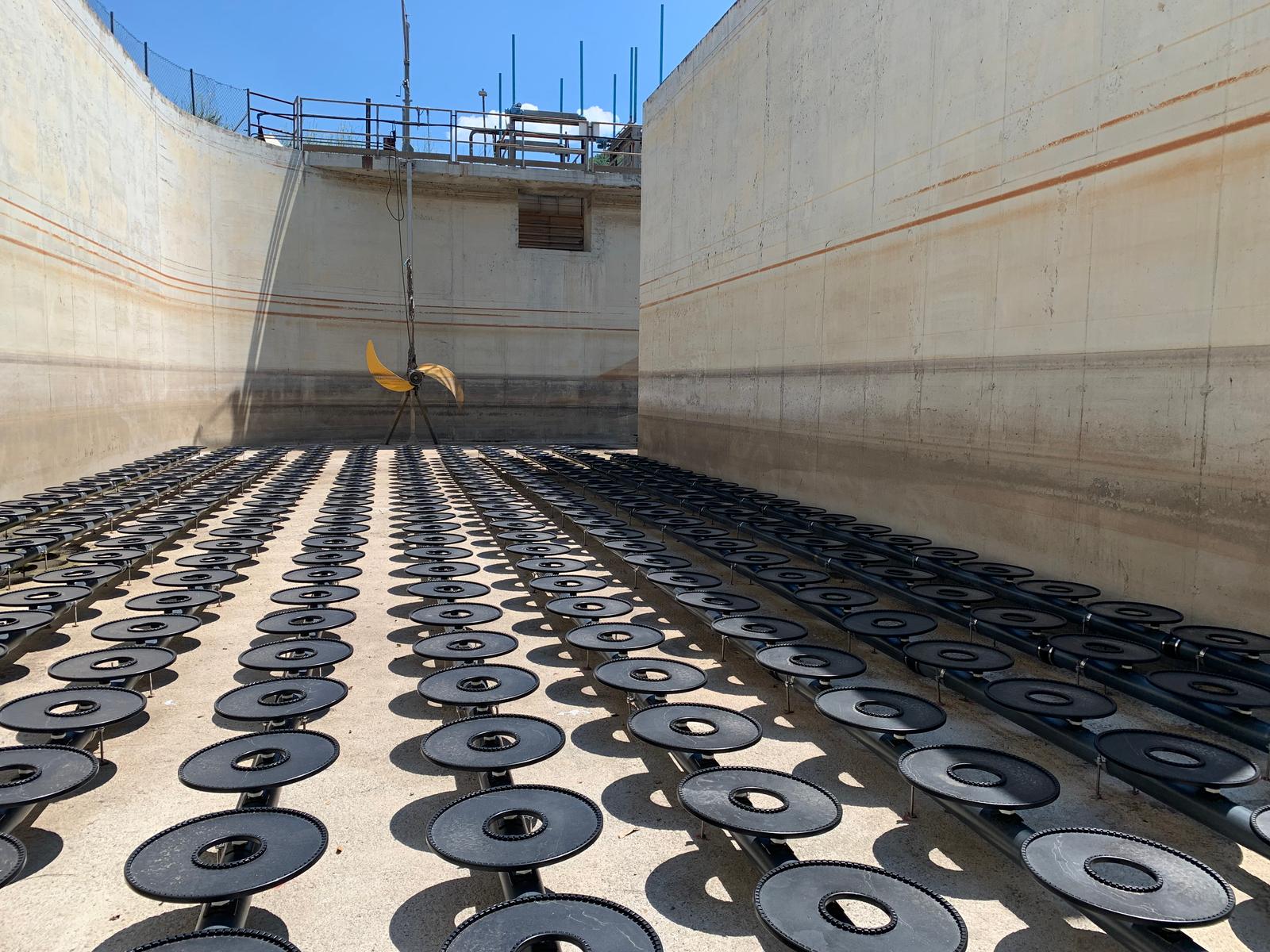
SSI’s diffuser membranes are compatible with most competitor diffuser bodies, which allows the aeration performance of an existing biological system to be improved without replacing basin structures or blower infrastructure. When additional biological capacity is needed, MBBR media can often be added to existing tanks, increasing treatment capability while avoiding new civil construction. 


For data centers facing compliance deadlines or aggressive water reuse goals, a retrofit evaluation is often the right first step. It clarifies what the existing biological system can handle, where it falls short, and which targeted upgrades close the gap without unnecessary cost or disruption.  

When to Evaluate a Retrofit

Data center wastewater treatment systems rarely fail all at once. More often, performance expectations change and existing biological treatment starts to show its limits. A retrofit evaluation is usually worth considering when one or more of the following conditions apply: 

Common triggers include: 


  • A revised or newly issued NPDES permit with tighter limits on BOD, TSS, or TDS
  • A municipal utility rejecting cooling tower blowdown or applying surcharges due to high TDS or elevated discharge temperatures
  • Downstream membrane systems underperforming, with more frequent cleanings, reduced recovery, or shorter membrane life
  • A new water reuse requirement driven by local regulation or internal sustainability goals
  • Data center expansion increasing blowdown volume beyond what the existing biological system was designed to treat
  • Aging aeration equipment approaching end of service life, prompting a replacement or upgrade decision


You may not need to replace your entire treatment system to meet new requirements. In many cases, downstream issues trace back to limits in biological treatment performance. Evaluating and upgrading the aeration stage often resolves those problems and does so at a fraction of the cost and disruption of a full rebuild.  

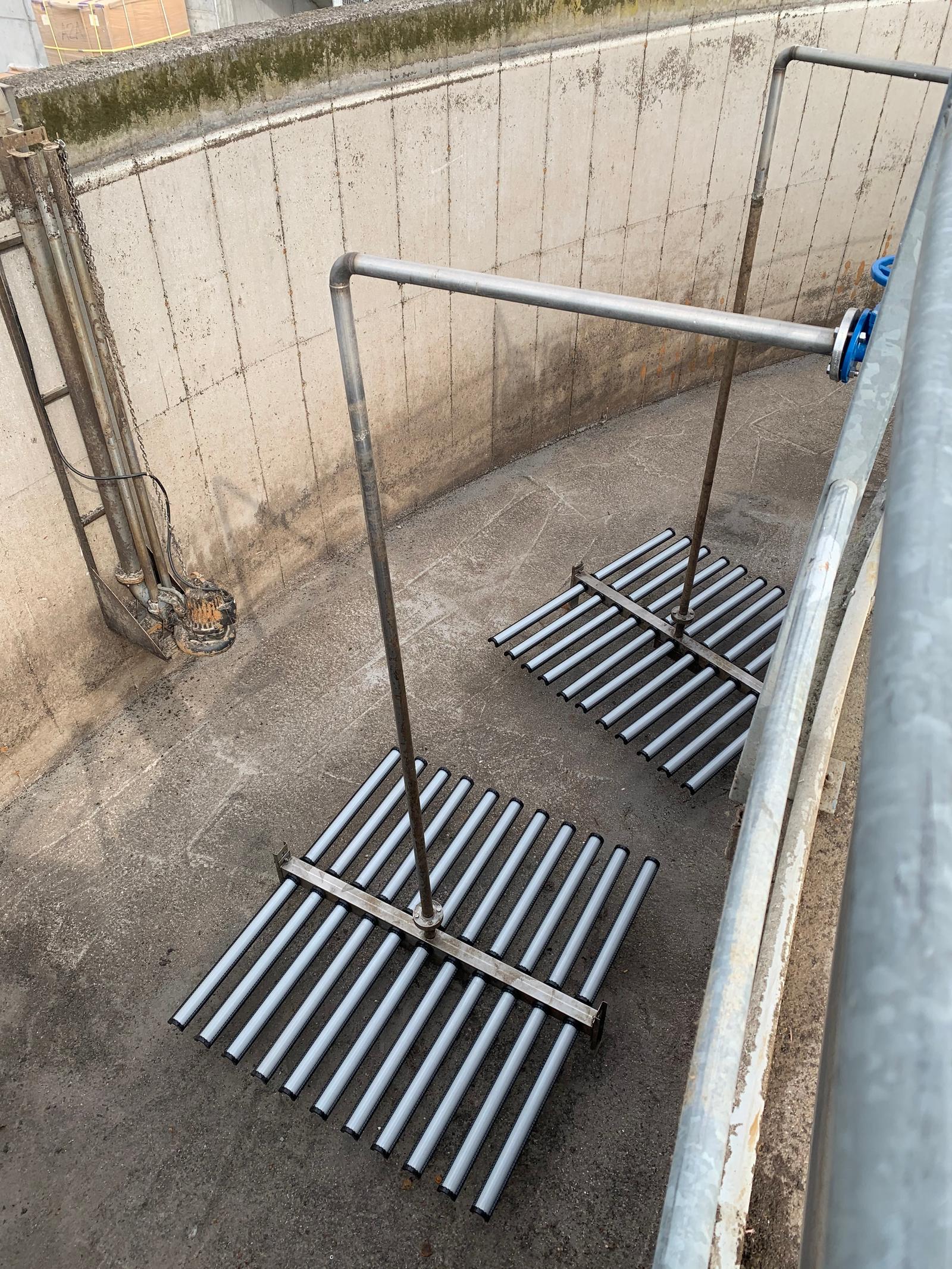
Aeration diffuser grid with retrievable tube assemblies for simplified maintenance and retrofit applications

Water Reuse, Sustainability, and What Regulators Are Requiring

Water reuse in data centers is no longer viewed only as a sustainability initiative. In a growing number of regions, it is becoming a practical requirement tied to permitting, water availability, and long-term operational risk. 

In water-stressed markets such as California, local authorities increasingly encourage or condition approval for new large data centers on the use of recycled or non-potable water for cooling where it is available. Other jurisdictions facing similar supply pressures are moving in the same direction. At the same time, many large data center operators have made public commitments to expand the use of reclaimed wastewater for cooling through partnerships with local utilities and purpose-built reuse infrastructure. 

The direction of the industry is clear. For most operators, the challenge is not whether reuse matters, but how to reach reuse targets using existing infrastructure. 

Biological aeration is a critical step in producing reuse-quality effluent. Whether using activated sludge or MBBR, properly designed aeration systems reduce BOD and COD to levels that allow downstream UF and RO membranes to operate reliably and cost-effectively. Without stable biological performance, reuse goals become difficult to achieve without excessive membrane fouling and increased operating expense. 

The sustainability case is also a financial one. In many markets, treated wastewater costs less than potable supply, particularly where water scarcity drives pricing or restrictions. Data centers that close the loop through internal water reuse can reduce operating costs and limit exposure to regulatory risk tied to high-volume freshwater withdrawal. Improvements in Water Usage Effectiveness, defined as total water use divided by IT equipment energy, provide a measurable outcome that supports both ESG reporting and regulatory compliance.

Why System-Level Engineering Matters More Than Component Selection

Choosing a membrane brand or a chemical program is not the same as designing a treatment system. One of the most common failure patterns in data center cooling water treatment is selecting capable components without fully integrating them. A well-specified RO system can still struggle when organic loading from upstream biological treatment exceeds what it was designed to handle, or when flow and pressure conditions across the system are not properly controlled through supporting infrastructure such as pumps and cooling equipment

SSI approaches data center cooling water treatment as a system-level engineering challenge. This begins with understanding the full operating picture, including influent characteristics, reuse or discharge targets, site constraints, and how the biological aeration stage interacts with downstream processes and upstream components such as chillers, pumps, and fluid transfer systems operating across the cooling loop. 

Our engineering team works collaboratively to support system design and implementation, including: 

  • In-house aeration system design from influent characterization through installation drawings 
  • Diffuser selection for activated sludge and MBBR applications 
  • MBBR solutions for compact footprints or variable loading conditions 
  • Blower packages sized to actual oxygen and mixing requirements 
  • Retrofit and upgrade solutions that improve aeration performance without full system replacement, while maintaining compatibility with existing pump systems and piping connections
  • Installation support and site commissioning 

For publicly funded data center projects, including federal facilities and public university computing infrastructure, select SSI-manufactured systems can be designed to meet Buy America Build America requirements, depending on project scope and specifications. 

With millions of diffusers installed across municipal and industrial facilities worldwide, SSI brings proven fine bubble aeration and MBBR technologies to data center cooling water applications. The focus is not only on component performance, but on how systems are sized, integrated, and applied to support reliable operation in reuse-driven environments.  Work With SSI on Your Data Center Cooling Water Treatment System 


Whether you are planning a new system, evaluating a retrofit, or troubleshooting performance issues, the first step is understanding your water conditions and treatment goals. 

Our engineering team works with you to assess your cooling water, discharge requirements, and reuse objectives, and develop an aeration approach aligned with your facility’s needs. 

Frequently Asked Questions

Cooling tower blowdown is wastewater discharged from a cooling system to prevent excessive buildup of dissolved solids. Evaporation concentrates minerals, salts, treatment chemicals, and organic material in the circulating water. Because of this organic load, cooling tower blowdown usually requires biological pretreatment before membrane-based reuse or discharge.